

Houston's SLAB Car Culture
In Houston's indigenous, localized hip hop culture, young men use large, motorized vehicles to express themselves. SLABs, as they are called, are typically over-sized American sedans that have been tricked out with explosive paint jobs and various types of vehicle adornment. SLAB owners invest thousands of dollars in the creation of their vehicles, purchasing their cars when they are in modest states and slowly converting them into something more elaborate. During this process, the vehicle becomes inscribed with individual experience and identity and broadcasts this to the outside world.

Photo: Mars Varela
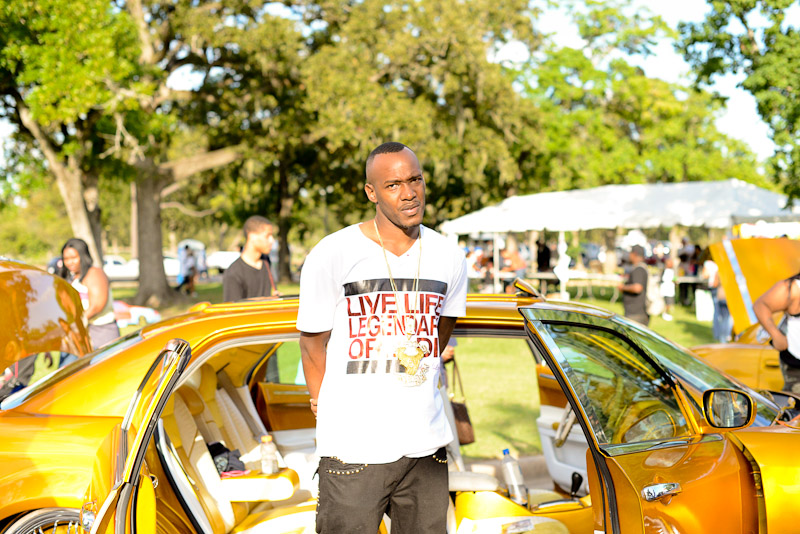
Gold Line, KILLA CAM.
Photo: Mars Varela

Gold Line, KILLA CAM.
Photo: MArc Newsome

Photo: Mars Varela

SLAB details.
Photo: Marc Newsome
SLAB culture lies at the intersection of multiple traditions within the African-American experience. It is a contemporary manifestation of the long-standing relationship between African-Americans, both middle and working class, and American luxury cars such as Cadillac. Facing various forms oppression, African-Americans have long viewed such vehicles as markers of social achievement and mobility. At the same time, hip hop culture's flair for manipulating older objects into new productions lies at the essence of SLAB culture's creative process.
SLAB Culture coalesced among young men living Houston's predominately Black neighborhoods in the early 1980s. At the center of its rise was the development of "swangas," a colloquialism for the rims that came standard on certain Cadillac models beginning in the 1970s. With "swangas" at the center, SLAB culture grew to involve various other types of vehicle modifications. The 5th Wheel is a "swanga" that is cut in half and enclosed in a fiberglass casing. It sits in a "bumper kit," that attaches it to the trunk of the car. Also adorning the trunk are "belts" which are chrome plates that run down each end. Interiors commonly feature leather seats along with wood-grain dashboards and steering wheels. Other features include trunk displays, European headlights, chrome grills, and powerful stereo systems.

Rapper Paul Wall.
Photo: Marc Newsome

Photo: Marc Newsome
Outside of the "swangas," "candy paint" is one of the most important aspects of SLAB culture. "Candy" is a reference to the high gloss, wet look of the paint when hit by sunlight. Candy paint involves the application of several layers of iridescent paint until the desired wetness is achieved. Within SLAB culture, "candy paint" is more than vanity. It is a way in which SLAB riders express community identity. Rides commonly group themselves into "SLAB Lines," which are paint color-coded car clubs representing particular neighborhoods. At various social events, SLAB lines enter, position themselves, and leave together in a grand display of fellowship.
SLAB culture has grown tremendously over the years. While the cars are not meant to be driven every day, they appear in a wide variety of community-based settings such as parties, concerts, and rallies as well as formal car shows. Alongside the settings, the participant base has grown as well. It has moved beyond its African-American origins and now reflects the demographic diversity of the Houston metropolitan area. SLAB culture is a homegrown creative exhibition of both personal and collective identity. Now over 30 years old, the tradition continues to function as one of the primary symbols of urban youth culture in Houston, Texas.
Langston Collin Wilkins, PhD

Photo: Mars Varela