-
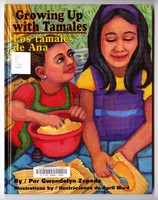 Growing Up with Tamales by Gwendolyn Zepeda
 Houston based author Gwendolyn Zepeda followed up her first two publications with Arte Público Press by authoring her first picture book, Growing Up with Tamales | Los tamales de Ana. The title, published under the Piñata Books imprint, tells the story of Ana and her family's tradition of making tamales every Christmas season.
-
 The Desert is My Mother by Pat Mora
 Pat Mora, author of The Desert is my Mother | El Desierto es Mi Madre, is one of many authors who published their first book with Arte Público early in their careers.
-
 Kikirikí by Diane de Anda
 Recognizing the need for making material available for an increasingly bilingual U.S. demographic and with the addition of Mark Jaffe to the Advisory Board, Arte Público launched Piñata Books in 1992.
-
 Tomás Rivera: The Complete Works by Tomas Rivera
 Tomás Rivera quite possibly has been the most influential voice in Chicano literature. This anthology, published by Arte Público's Press in 1995 includes his masterpiece "... y no se lo tragó la tierra/. . .And the Earth Did Not Devour Him" and the sum total of his published works, in English and Spanish, as well as many posthmous works. An exemplar of among writer before him, his contemporaries, and his successors, Rivera's writing intimitately focuses on the struggles of Mexican-Americans in defining their identities and pursuing a better life through education.
-
 Desert Blood: The Juarez Murders by Alicia Gaspar de Alba
 Winner of the 2005 Lambda Literary Award for "Best Lesbian Mystery" and the 2006 Latino Book Award for Best English Language Mystery, Desert Blood is another example of complex Latina/o narratives touching on the experience of women, non-heterosexual identities, and the violence of the Border.
-
 La Carreta Made a U-Turn by Tato Laviera
 A part of the blossoming Nyorican wave, Tato Laviera's book, La Carreta Made a U-Turn, was the Press' first publication and explores the immigrant experience of Puerto Ricans.
-
 Que Pasó, Special Election Issue
 Running parallel to the rise of Arte Público Press in the 1970s, Latinos, like the members of the Political Association of Spanish-Speaking Organizations were demanding a seat at the table and actively pursuing representation in politics. PASSO grew out of the Viva Kennedy-Viva Johnson clubs of the 1960 presidential campaign, and would lay the foundations for more radical organization such as the Raza Unida Party.
-
 Invitation to Chicano Students
 After making the move to the University of Houston, in December of 1979, Arte Público's Press and journal division, Revista Chicano-Riqueña, continued to bridge the vibrant Latina/o community with scholarship. The topic of conversation seen here, immigration, is one example of the Press' timeliness and place in social justice movements.
-
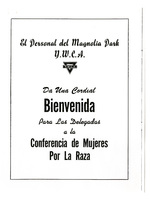 National Chicana Conference
 The Conferencia de Mujeres Por la Raza, also known as the National Chicana Conference, was the first interstate assembly of Mexican-American feminists organized in the United States. It was held at the Magnolia Park YWCA in Houston on May 28–30, 1971.
-
 The House on Mango Street by Sandra Cisneros
 The critically acclaimed novella by Sandra Cisneros was first published by Arte Público in 1984, and was the recipient of the Before Columbus Foundation's American Book Award in 1985.
-
 To the Last Man I Slept With by Gwendolyn Zepeda
 Arte Público published Houston's first Poet Laureate, Gwendolyn Zepeda's first book, a short story collection published in 2004. Humorous and poignant, the book continues the Press' tradition of depicting the ever evolving experiences of Latinas.
-
 Leonor Villegas de Magnón and Aracelito Garcia with flag of La Cruz Blanca
 Leonor Villegas de Magnón, founder of La Cruz Blanca, was born in Nuevo Laredo, Mexico, in 1876. Sympathetic to the 1910 Mexican revolutionary cause and nicknamed La Rebelde, Leonor Villegas de Magnón, with her friend Jovita Idar, wrote for La Crónica, a Laredo newspaper published by Nicasio Idar.
-
 Revista Chicano-Riqueña
 Dr. Nicolás Kanellos alongside Dr. Luis Davila founded Revista Chicano-Riqueña while in Indiana to offer a forum for Latinos throughout the United States to publish their literary works and art in 1973. More focused on anthologies, the journal was the seed that would later be renamed The America's Review and lead to the founding of Arte Público Press in 1979.
-
 Dew on the Thorn by Jovita González
 In 1997, Dew on the Thorn, one of the few recovered works authored by folklorist, historian, writer, and teacher, Jovita González de Mireles (1904–1983) was published posthumously by Arte Público's Recovery Project, six decades after it was penned.
-
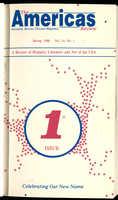 The America's Review, Vol. 14, No. 1
 Originally founded in 1973 under the name "Revista Chicano- Riqueña," the journal changed its name to The America's Review seeking to acknowledge the increasingly diverse make up of Latina/o's in the United States.